Edition · cover shown
Hachette UK
Edition details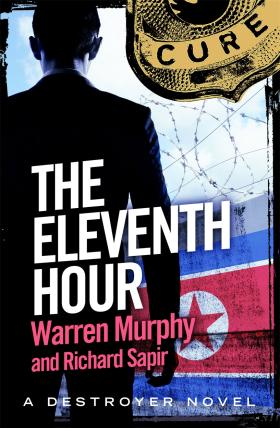 The Destroyer#70The Eleventh Hour
The DestroyerBook 701987
A Detroit arson investigation draws Remo and Chiun into a much larger crisis when a journalist’s story about Sinanju reaches Soviet intelligence. As Chiun returns to his village and Remo confronts questions of home, succession, and an unsettling voice, the Soviets try to trade CURE’s exposure for control of the Master of Sinanju.
Korean-American journalist Sammy Kee travels to North Korea to film Sinanju’s history and the Master’s connection to the United States. KGB Colonel Viktor Ditko steals Kee’s footage, seeks leverage in Moscow, and sends him back for more; Kee records Chiun and Remo, murders a village boy while disguised as a dragon, and is then shot by Ditko after returning with the tape. In Detroit, Remo and Chiun investigate Devil’s Night arson and Remo kills organizer Moe Joakley after a fire injures Chiun. Chiun appears gravely ill, so Remo takes him home to Sinanju; there he presses Remo to succeed him and support the village. Chiun tells Remo the legend that a future white pupil will become Shiva the Destroyer and succeed the Master.
Mah-Li, an ostracized veiled woman, tells Remo the Lost Master Kojong legend; Remo becomes attracted to her and agrees to stay. Chiun then dispenses with the ceremony for the moment and declares Remo the new reigning Master; the later formal investment remains to be done properly, and Remo and Mah-Li are not yet married. The Soviets use Kee’s footage to force the unnamed U.S. President to order CURE disbanded and permit Soviet control of Chiun and Remo. Smith travels to Sinanju and transfers the contract; the Soviet troops then betray the agreement and attack the village. Remo fights back but surrenders to save the villagers and Mah-Li.
Smith tries to commit suicide, but Remo revives him. Remo enters Moscow in an experimental aircraft, battles his way to the Kremlin, and reunites with Chiun, who has forced the Soviet General Secretary to destroy his tapes and release the contract. Its nontransferability clause voids Soviet control. On return, Chiun admits no literal death date and Remo suspects the illness was a ploy to bring him home and strengthen his Sinanju identity against Shiva; Chiun deflects but then agrees to fund Mah-Li’s dowry. Remo chooses to remain in Sinanju and become Chiun’s eventual successor. Smith’s call from the President says CURE may resume operations; Remo declines to return, while allowing Smith to continue the search for Remo’s biological parents.
Full articles
Kee, an American journalist born in San Francisco, enters Pyongyang and seeks asylum at the Soviet embassy. In interrogation, he tells Ditko why he filmed Sinanju and its alleged American connection.
Remo and Chiun patrol Detroit during its arson curfew. A teenager points Remo toward organizer Moe Joakley; Remo reports to Smith, then enters a burning home to rescue a family.
A collapsing house injures Chiun and Remo appears to speak in a voice Chiun associates with Shiva. Remo later confronts and kills Joakley; news calls the killer a runaway robot.
After learning of Joakley’s death, Remo hears Dr. Gale say Chiun’s body is exceptionally symmetrical but that he appears to be dying without a physical diagnosis. Chiun asks to return to Sinanju.
Smith arranges transport for Remo and Chiun, while Ditko consults a North Korean liaison and confirms Sinanju is a restricted fishing village.
Aboard the USS Darter, Chiun tells Remo his history and recounts his former pupil Nuihc. Captain Leahy delivers Chiun, Remo, gold and trunks to Sinanju.
Ditko carries Kee’s first tape and transcript to the Soviet General Secretary, who directs him to send Kee back to Sinanju for more evidence.
Chiun returns to the village and presents Remo as his adopted son. He tells the Great Master Wang prophecy, which Remo’s recent possession-like episode appears to echo.
Kee re-enters Sinanju, kills a village boy while taking his dragon costume, then films Chiun’s account to the villagers. Remo reluctantly says he will assume the succession and support the community.
Remo meets the veiled Mah-Li and confides in her. Kee follows Remo and is caught with his camera; Remo and Chiun learn of the murdered boy.
Ditko enters Sinanju, retrieves Kee’s tape and kills him. The Soviet General Secretary receives a poor transcript and begins to treat the recording as proof of U.S. activity.
Remo’s attraction to Mah-Li grows. She tells him of twins Kojing and Kojong and a prophecy that a descendant of Kojong could save the line if no male heir remained.
At a secret Helsinki meeting, the Soviet leader demands CURE, Remo and Chiun; the unnamed U.S. President agrees to disband the agency. Smith tells his wife and leaves for Sinanju.
Remo rejects Smith’s offer to take him home, and Smith tells Chiun the contract is being transferred to the Soviets. Smith triggers the CURE archive erasure process, though the Folcroft system later comes back online.
Chiun accepts Soviet service and dispenses with the Master-investment ceremony for the moment, declaring Remo the “new reigning Master.” Soviet troops attack; Remo surrenders to protect the villagers, Smith rescues him from the firing squad and survives a poison attempt, then sends him toward Moscow.
Remo is inserted into Red Square and kills seven militiamen with coins. He creates havoc across Moscow and meets Marshal Steranko, asking for access to Chiun.
Remo kills guards and Ditko while looking for Chiun. Chiun forces the General Secretary to destroy the tapes and voids the contract through a nontransferability clause; the Soviet leader arranges their departure.
Chiun and Remo return to Sinanju; Remo learns CURE may resume, chooses to stay, and agrees Smith can continue searching for his biological parents. Remo accuses Chiun of staging his dying routine; Chiun scoffs, says “Nonsense,” and deflects without giving a straightforward account. Chiun also says Remo is not yet properly invested and the ceremony must be done correctly, then provides Mah-Li’s dowry.
Edition · cover shown
Hachette UK
Edition detailswitness:00000204:ch01:p0082witness:00000204:ch02:p0001witness:00000204:ch08:p0039witness:00000204:ch13:p0030witness:00000204:ch15:p0078witness:00000204:ch01:p0058witness:00000204:ch03:p0151witness:00000204:ch08:p0140witness:00000204:ch10:p0118witness:00000204:ch11:p0036witness:00000204:ch12:p0044witness:00000204:ch13:p0094witness:00000204:ch14:p0087witness:00000204:ch15:p0115witness:00000204:ch16:p0049witness:00000204:ch17:p0097witness:00000204:ch18:p0070witness:00000204:ch18:p0101witness:00000204:ch18:p0112Names are the bibliography’s title-level “written by” attribution key, not a verified edition byline. credited_authors is null because no first-edition cover/title page was checked. A creator name in the general franchise metadata must not be treated as proof of sole drafting.
registration-declared first publication: 1987-09-08. CPRS record field is the registrant/depositor-reported first-publication date, not independent retail/on-sale verification; no print copy inspected. Source
The Eleventh Hour:
Publisher's description: Hachette supplies only its general series overview here; it characterizes the novels as action-led stories mixing comedy and mysticism.
Current U.S. President: historical identity unresolved.
John F. Kennedy
strong cross-book inference
Book 70 gives no personal name or calendar date, and there is no direct source-to-source identity statement. Book 26 explicitly names John Kennedy as CURE’s founder (witness:00000075:ch01:p0148, p0150), making Kennedy a strong qualified series-context candidate. The hypothesis is not a settled source fact or entity merge.
Unidentified U.S. President succeeding the founder; the source does not identify this person as the present incumbent.
none
The source provides no personal name, year, or direct identity link. Keep this narrative officeholder distinct from the other unnamed Presidents. No external historical identification has been made.
Current U.S. head of state in the main events; name, administration, and calendar year are not provided.
none
The source provides no personal name, year, or direct identity link. Keep this narrative officeholder distinct from the other unnamed Presidents. No external historical identification has been made.
Mikhail Gorbachev (strong office-and-birthmark allusion; unnamed in Book 70)
strong historical compatibility; no explicit local identification
The source gives no name or story year. A September 1986 USIA report preserved at the Reagan Library mentions General Secretary Gorbachev’s head birthmark, making the office-plus-mark combination a strong historical allusion. Compatibility does not verify the fictional actions, establish a calendar year, or make his name locally observed. See the batch compatibility note for report provenance and scope.
All 155 books in The Destroyer
Spot a mistake, or know something this page doesn’t?Suggest a correction