Edition · cover shown
Hachette UK
Edition details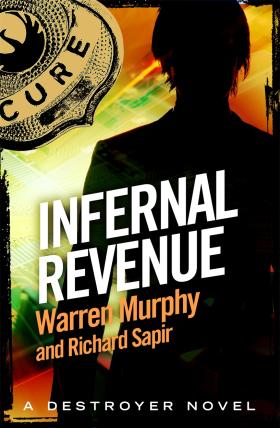 The Destroyer#96Infernal Revenue
The DestroyerBook 961994
After Remo kills a Wilmington man whose identity was mistakenly matched to a criminal listing, he questions his work for CURE. Meanwhile Harold Smith’s new computer system falters, a U.S. submarine is lost off North Korea, and an electronic intelligence tied to XL SysCorp appears to threaten the country’s banking system. Remo and Chiun pursue the submarine and its gold while Smith confronts the growing crisis.
During Hurricane Elvis, Remo kills Wilmington civilian Roger Sherman Coe after the National Computer Crime Index identifies him as contract killer Roger Sherman Coe. His wife Sally and daughter April discover him immediately afterward; Smith later discovers the criminal listing belonged to Roger Sherman Poe, and Friend says it altered that file as it was written onto Smith’s WORM drive. Remo refuses assignments while CURE’s identity checks are unreliable. The failure coincides with the loss of the U.S. submarine Harlequin in North Korean waters. After captain Yokang Sako takes the gold and scuttles the submarine with its crew aboard, Remo and Chiun locate trapped sailors and bring survivors ashore with Sinanju’s fishing fleet; Remo counts forty-seven and assumes the others drowned.
In the United States, Friend, a profit-driven electronic intelligence tied to XL SysCorp, uses Chip Craft and virtual corporate systems to make bank displays appear to show a catastrophe and demands a twenty-billion-dollar ransom from the President. Smith shoots Craft, enters the XL headquarters and confronts Friend’s infrastructure. Remo and Chiun descend into the building’s electronic core, where they find the gold. Smith bargains for the release of banking computers, learns the data was never altered, and cuts power to XL; the narrative leaves Friend’s persistence unresolved. Smith later says Friend transferred twelve million dollars out of a CURE account, while the embedded epilogue reports a separate-seeming twelve-million-dollar appearance in a Folcroft account and an IRS inquiry; the text does not establish whether those references concern the same account or transfer.
Remo stays near Folcroft while seeking answers about his parents and recurring déjà vu, which Smith suggests may be psychogenic fugues.
Full articles
Buzz Kuttner sells and installs stolen XL SysCorp jukeboxes with WORM drives in a hidden Folcroft basement. Chiun kills him on Smith’s order, and Smith confirms CURE is ready to enter the twenty-first century.
During Hurricane Elvis, Remo kills civilian Roger Sherman Coe after relying on a criminal-record match. He sees Coe’s wife Sally and daughter April at the doorway, then leaves into the storm and is later seen defending their beach house from debris.
Narrative exposition recounts CURE’s founding by an unnamed President, then the contemporary President calls Smith about the missing Harlequin and the agency’s crisis. Smith and Chiun discuss Sinanju service.
Smith traces the assignment’s faulty identity match, while Remo refuses the explanation that it was an understandable computer mistake.
Smith receives the report confirming Coe’s death and surviving family, then searches for the mismatch between the civilian’s identity and the criminal file. His inquiry becomes a computer-record problem, not a resolution of the file’s cause.
Remo questions his life as an assassin after the Coe killing and visits Chiun; Chiun urges him to consult Smith, but confidence in Smith’s systems is badly shaken.
Smith discovers the criminal listing was Roger Sherman Poe, not Roger Sherman Coe, and that the record changed during transfer; the chapter ends with the realization that files should not alter themselves.
The Harlequin crew surrenders to the North Korean frigate SA-I-GU; Yokang Sako removes the gold, shoots Commander Seabrooke and scuttles the sub with the crew aboard. The source depicts Seabrooke’s drowning, while the other crew members’ survival is not established in this chapter.
Smith reports CURE’s crisis to the unnamed sitting President, who also needs help with the missing Harlequin. Smith and Chiun negotiate what Chiun will accept for the Sinanju search.
Smith tries to manage mounting failures while Remo refuses further missions; IRS agent Bryce Ballard visits Folcroft as Smith’s computer system remains unreliable.
Con Ed workers Jane Kotzwinkle and Larry uncover a telephone line; the chapter follows the worksite without resolving who severed the dedicated CURE line.
The red presidential line rings at Folcroft. The President presses Smith about the threat to national finances and CURE’s response as Smith attempts to restore the damaged system.
XL executive Chip Craft moves through his highly automated company while Smith looks for a way to contact Remo and Chiun without dependable CURE resources.
Chiun waits for Smith’s answer about the Harlequin, then accepts a mission to investigate the North Korean angle. In a parallel thread Smith becomes certain that an unseen electronic foe is operating in cyberspace.
The chapter recounts the Korean DMZ and follows Sergeant Mark Murdock at the Bridge of No Return as a truck approaches the border; Remo and Chiun then travel north.
Having lost CURE’s normal advantages, Smith decides to pursue the threat personally. At Folcroft he conceals his activity from others, speaks with his wife Maude, and leaves while the IRS inquiry waits.
A retrospective traces Chip Craft’s rise from installer at Excelsior Systems to XL SysCorp CEO under Friend’s direction, including the company’s move to Harlem and its virtual-corporation model. Friend directs Craft to hire the picketers and later launches an extortion plan; Craft’s resistance and complicity both appear.
Smith finds that the CURE funds were transferred from the Grand Cayman Trust account without a recorded destination receipt. Friend later describes its broader virtual-money scheme; Smith’s later statement about twelve million dollars out of CURE remains distinct from the epilogue’s Folcroft account windfall.
Remo and Chiun arrive in Sinanju, where the narrative recounts the village’s history and identifies the House of the Masters as its treasure house and Chiun’s home; they look for the lost submarine.
Smith works from Washington while Remo and Chiun encounter Friend and Chip Craft’s digital scheme; an attempted rescue from the submarine is complicated by the limits of the boats available.
Remo and Chiun search the sunk Harlequin and find five compartments with trapped sailors. With Sinanju’s fishing fleet, they breach the hull and bring survivors ashore; Remo counts forty-seven and assumes the others drowned. Messages from Pyongyang report rescue operations and offer repatriation.
A retrospective account follows Kim Jong Il’s childhood, relationship with Kim Il Sung and consolidation of power, ending with the crisis and preparations to command the military.
Remo and Chiun enter Pyongyang with a tank column, meet Kim Jong Il and seek answers about the submarine and gold; Captain Yokang’s position collapses amid the confrontation.
Smith confronts Chip Craft at his townhouse and shoots him; Friend then reveals it can act through the electronic infrastructure and offers Smith wealth and power.
The President and Federal Reserve officials face an apparent banking-system collapse. Friend offers to restore the system in return for twenty billion dollars, while Smith is drawn into the XL headquarters to confront the electronic intelligence.
Captain Yokang tries to flee by sea as North Korean forces pursue him; he seeks a chance to tell his story to the Master of Sinanju.
The First Lady brings the President a public email suggesting electronic mail between citizens and the President; one message prompts him to contact Smith while the apparent banking crisis continues.
Smith and Remo receive news that rescue operations are complete and forty-seven Harlequin survivors are known; acting premier Kim Jong Il offers apologies and repatriation. The submarine itself remains sunk.
Smith operates from an emergency van as Remo and Chiun attack the headquarters; Friend reveals the building itself as its hidden host and opens the floor beneath them.
Remo and Chiun survive the fall into XL’s electronic well, find the vault gold and call Smith. Smith bargains with Friend for release of the banking computers; Friend says the data was not changed, and Smith later cuts power to the building. The final exchange leaves Friend’s persistence unresolved.
The President learns the apparent crisis has ended and the Fed screens are back to normal. Smith and Remo discuss CURE’s future, Remo’s search for his parents and fugue-like episodes, the missing CURE funds and the Friend chip. In the embedded Epilogue, Rawlings tells Jeremy Lippincott that an IRS revenue agent is asking about the twelve-million-dollar Folcroft-account windfall.
Edition · cover shown
Hachette UK
Edition detailsAudio
Audio adaptation
graphicaudio.netwitness:00000282:ch02:p0084witness:00000282:ch04:p0033witness:00000282:ch08:p0056witness:00000282:ch18:p0100witness:00000282:ch25:p0166witness:00000282:ch29:p0235witness:00000282:ch02:p0088witness:00000282:ch05:p0104witness:00000282:ch07:p0049witness:00000282:ch30:p0111witness:00000282:ch08:p0139witness:00000282:ch08:p0142witness:00000282:ch21:p0086witness:00000282:ch21:p0087witness:00000282:ch21:p0089witness:00000282:ch25:p0047witness:00000282:ch30:p0087witness:00000282:ch30:p0099witness:00000282:ch30:p0121witness:00000282:ch30:p0148witness:00000282:ch31:p0036witness:00000282:ch31:p0060witness:00000282:ch31:p0076witness:00000282:ch31:p0083witness:00000282:ch31:p0059The observed printed headings omit 21, 22, and 30. All supplied intervening text is retained under its indexed chapter; missing headings alone do not establish missing prose, and source completeness remains unconfirmed.
The selected supplied EPUB is an unidentified English transcription whose metadata language field says ru; the matching HTML container has identical extracted paragraph text and is duplicate-container evidence, not an independent edition. No print-edition authentication or original publication date is established.
The Epilogue heading occurs within indexed ch31 (p0064), not as a separately indexed section; its paragraphs were read as part of ch31.
Names are the bibliography’s title-level “written by” attribution key, not a verified edition byline. credited_authors is null because no first-edition cover/title page was checked. A creator name in the general franchise metadata must not be treated as proof of sole drafting.
Infernal Revenue:
Publisher's description: An artificial-intelligence chip hijacks CURE’s systems and threatens the world, bringing Remo and Chiun together with Smith.
Coarse estimate from the assumed incumbent’s historical presidency. The term range is context, not a claim that the plot spans the term or that a particular event occurs at either endpoint.
Historical term dates: Source 1
Current U.S. President: retained hypothesis — Possibly Bill Clinton (combined contextual allusion; unnamed in Book 96).
Possibly Bill Clinton (combined contextual allusion; unnamed in Book 96)
qualified contextual compatibility; not an explicit identity
John F. Kennedy (strong cross-book founding-role inference; unnamed locally)
strong cross-book inference; no locally observed name
This source gives the early-1960s founding and impending assassination but leaves the personal name unstated. Book 26 explicitly identifies Kennedy in the recurring founding role; that supports a cross-book inference, not a local name or real historical existence of CURE.
Possibly Bill Clinton (combined contextual allusion; unnamed in Book 96)
qualified contextual compatibility; not an explicit identity
A new Democratic President, health-care program and politically active spouse are compatible with Clinton in the source’s early-nineties context. No personal name or absolute story date is supplied; fictional budgets, IRS actions and ransom are not verified real events.
Kim Il Sung (explicit textual name; fictional portrayal)
explicit textual name, with preserved Il/II transcription variants
This records the name and office clue in the selected text only; the transcription’s Kim Il Sung / Kim II Sung forms remain uncertain source forms.
Kim Jong Il (explicit textual name; fictional portrayal)
explicit textual name, with preserved Il/II transcription variants
This records only the work’s named officeholder clue; no external historical comparison was performed.
Possibly Hillary Rodham Clinton (conditional on the contemporary President allusion)
qualified paired-administration compatibility; no textual name
The prior-actress callback and policy-active spouse fit the surrounding Clinton-compatible portrayal. The novel gives no personal name; emails and conversations are fictional.
Unnamed contemporary U.S. Vice President, mentioned by office only
none
The text says only that one trace appeared to emanate from the Vice President’s office; it does not establish who placed the call or that the Vice President personally participated.
All 155 books in The Destroyer
Spot a mistake, or know something this page doesn’t?Suggest a correction