Edition · cover shown
Hachette UK
Edition details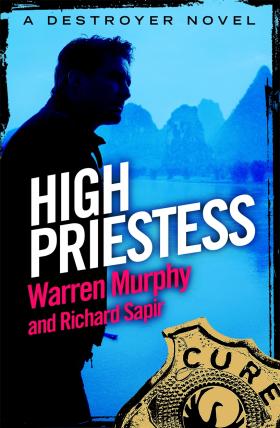 The Destroyer#95High Priestess
The DestroyerBook 951994
A Tibetan succession crisis brings the isolated monk Lobsang Drom and the Mongol Kula to CURE operative Remo Williams and his teacher Chiun. Their search leads to Squirrelly Chicane, a flame-haired American actress who is accepted as the next Bunji Lama and travels to Tibet amid Chinese resistance and a growing political crisis.
The prologue depicts the poisoning of Gedun Tsering, the forty-sixth Bunji Lama, by regents seeking a compliant successor. To keep them from controlling another child, he invents a false prophecy of a flame-haired next incarnation who will not remember the former life; he privately believes his reincarnation cycle has ended. A red-haired infant is born at the moment he dies, but the prologue does not establish that the fabricated prophecy is true. Sixty years later, Lobsang Drom joins Kula, emissary of Boldbator Khan, to find the next Bunji. Remo and Chiun join their search for payment; Chiun uses a television program as an oracle to identify actress Squirrelly Chicane.
They and the Tibetan visitors accept Squirrelly as the new Bunji, while Remo and Chiun privately seek the promised gold. A Chinese assassination attempt at Squirrelly’s Malibu party is stopped by Remo and Chiun. The unnamed sitting President asks CURE director Harold W. Smith to protect Squirrelly at his wife’s urging, but Smith declines because he considers it outside CURE’s mandate. The First Lady’s influence and Squirrelly’s trip raise tensions with China. Smith later sends Remo to Tibet when he judges the Chinese occupation a larger strategic threat. Squirrelly meets the Dalai Lama in India, who accepts her as Bunji after she presents the artifact identified as her Oscar and urges nonviolence; she declares war.
At dinner, a food taster dies from poisoned food. The Tibetan cook says a Chinese man coerced him to look away while the man poisoned Squirrelly’s bowl; Kula kills the cook after the confession. At the border Wangdi Chung says he failed to poison the Bunji, but the source does not establish whether he means the same plot or another attempt; Chinese guards shoot him after his warning about the procession. The procession passes the checkpoint and enters Tibet. Remo enters by truck, joins resistance figures whose title Bumba Fun passes among different people, and fights PLA forces as villagers call him Gonpo Jigme. Chiun reaches Lhasa, frees Squirrelly and the others from Drapchi Prison, and guides them through the Potala’s hidden passage.
Squirrelly claims the Lion Throne. Remo’s resistance group advances on Lhasa, while an avalanche sweeps down as Squirrelly starts singing, burying Chinese forces; she claims credit, while its cause remains unestablished; Chiun still decides they must leave. At Gonggar Airport the child Tashi and Squirrelly face each other as spiritual rivals. The Chinese security minister detonates a bomb hidden in the Tashi’s prayer wheel; both figures vanish, and the narrative describes red rain as witnesses argue over whose drops they capture. Remo and Chiun escape in a turboprop with Kula. In Massachusetts Chiun explains that he traveled to repay an inherited Sinanju debt for a past Master’s mistaken killing of a child, and offers his contested explanation that Gonpo is Shiva and that Shiva’s spirit rode Remo.
The epilogue depicts Squirrelly’s apparent rebirth as Dra Drang’s red-haired son; he remembers the former life and plans to become the Bunji before pursuing a film career. The source leaves the supernatural explanation disputed by Remo, while the epilogue presents the rebirth as lived experience.
Full articles
Lobsang Drom leaves his Himalayan isolation after Kula arrives with a mission from Boldbator Khan: find the missing Bunji Lama.
Remo foils a bank robber and the narration recaps his recruitment into CURE and the organization’s early-1960s founding.
Kula locates Remo and Chiun, introduces the old Bunji’s mummy, and negotiates a roomful of gold for Chiun’s search for the new Bunji.
Chiun uses a television program as an oracle to identify a flame-haired potential Bunji.
Remo recognizes the proposed incarnation as actress Squirrelly Chicane; the party agrees to pursue the eccentric star.
The search moves from the oracle’s identification toward Squirrelly’s home and the promised gold.
On her sixtieth birthday, Squirrelly expects spiritual wisdom and instead remains focused on her celebrity and career.
At LAX, Lobsang and Kula look to Remo to continue the search for the Bunji, with Squirrelly now identified as their candidate.
Remo and Chiun privately weigh the gold offered for the search while Squirrelly is treated as the new Bunji.
Squirrelly tells her mother and agent about being selected as Bunji and proposes going to Tibet, mixing the new role with her movie plans.
The group’s departure preparations sharpen Remo’s frustration with Chiun and the opaque bargain.
Denholm Fong arranges an attack on Squirrelly’s Malibu party after learning she has claimed to be the Bunji.
The unnamed sitting President asks Smith to protect Squirrelly; Smith declines, while the First Lady’s involvement complicates the request.
Squirrelly misses her Malibu home while the bodies of the Chinese attackers wash ashore.
China’s premier and security minister discuss the Bunji and risks posed by the First Lady’s interest.
A large FedEx shipment arrives at Castle Sinanju as Remo questions why Chiun went to Tibet.
The Dalai Lama accepts Squirrelly as Bunji after she presents the Oscar and counsels nonviolence; she declares war, then a food taster dies from poisoned food and the cook says a Chinese man coerced him.
Smith connects the Chinese deaths in Malibu with Chiun’s departure and sends Remo to Tibet after assessing the regional danger.
At the border, Chinese agent Wangdi Chung admits his failed poisoning attempt; after his warning is translated, Chinese guards shoot him and flee as the procession passes.
The Bunji’s procession continues through mountain passes as Squirrelly suffers the journey and her followers interpret her discomfort as shared spiritual trial.
Remo enters Tibet by truck and contacts the Chushi Gangdruk resistance through a Bumba Fun.
Chapter 22 opens with a later scripture-style account: Squirrelly is taken to Drapchi, while the procession’s fate is said to be unknown and conflicting versions include a possible massacre. The narrative then cuts to Squirrelly, Kula, and Lobsang in cells; they begin planning an escape.
In Tingri, Captain Ran Guohua forces villagers onto rooftops during a storm to “catch lightning.” Remo intervenes, pulls Kelsang Darlo clear of a strike, kills the PLA soldiers including Guohua, and leaves in a commandeered jeep. Kelsang and other villagers interpret Remo as Gonpo Jigme; the text does not establish a supernatural cause.
Lhasa looks to the Potala and its Lion Throne as Chiun enters the city in disguise.
Remo’s Tibetan journey intensifies his sense of familiarity with the mountains and his uncertain connection to the local god Gonpo.
Chiun is escorted into Drapchi Prison, where he begins his effort to reach Squirrelly.
After the PLA commander shoots the elder Bumba Fun, Remo kills the attacking force. The young woman explains that many Chushi Gangdruk generals use the title Bumba Fun as a decoy; she identifies the dead elder as her father and says she will take his place. She and the nomads refuse to evacuate, and later a PLA helicopter attacks the camp. Remo destroys the helicopter but does not know who Gonpo Jigme is.
Squirrelly complains about prison life while her captors and allies make plans.
China’s premier chooses the Tashi as a rival “small flame” and sends the child toward Lhasa.
Chiun, Kula, Lobsang, and Squirrelly escape the prison under cover of night.
Remo meets a tank column in the mountains, disables its tracks and crew, and blows up the three T-62s.
Former abbot Thondup Phintso guides Chiun and the others through the Potala toward the Lion Throne.
Remo joins another Bumba Fun and Khampa resistance fighters as they move toward Lhasa.
Squirrelly assumes the Lion Throne, but Thondup Phintso discovers her identity and alerts the authorities.
Chiun leads the fugitives through a concealed passage beneath the Potala and collapses it behind him. They emerge in a temple cave overlooking the palace, now under heavy PLA deployment, and later escape by helicopter.
Remo destroys the barrels of two T-72s, opening a route into Lhasa as the Tashi and security minister arrive at Gonggar.
As encircled Squirrelly begins singing, an avalanche descends across PLA positions below. The group survives under cover; Squirrelly claims she defeated the Chinese with her voice, but Chiun says they are not free and decides they must flee.
At Gonggar Airport, the child Tashi Lama and Squirrelly face each other as spiritual rivals. The unnamed security minister detonates the bomb hidden in the Tashi’s giant prayer wheel. The blast throws people back and both figures disappear; the narrative describes red rain and says witnesses dispute whose life-drops they caught. Neither body is recovered.
Remo and Chiun return to Massachusetts; Chiun explains the old Sinanju debt and his interpretation of Gonpo, while the epilogue depicts Squirrelly reborn as a red-haired boy.
Edition · cover shown
Hachette UK
Edition detailsAudio
Audio adaptation
graphicaudio.netwitness:00000279:foreword:p0017witness:00000279:ch01:p0001witness:00000279:ch01:p0044witness:00000279:ch02:p0072witness:00000279:ch05:p0001witness:00000279:ch13:p0085witness:00000279:foreword:p0002witness:00000279:foreword:p0004witness:00000279:ch04:p0001witness:00000279:ch12:p0001witness:00000279:ch13:p0111witness:00000279:ch18:p0001witness:00000279:ch19:p0001witness:00000279:ch19:p0052witness:00000279:ch20:p0049witness:00000279:ch21:p0028witness:00000279:ch23:p0080witness:00000279:ch26:p0001witness:00000279:ch30:p0001witness:00000279:ch34:p0022witness:00000279:ch37:p0061witness:00000279:ch38:p0117witness:00000279:ch38:p0124witness:00000279:ch39:p0041witness:00000279:ch39:p0061witness:00000279:ch39:p0095witness:00000279:ch39:p0103witness:00000279:ch17:p0107witness:00000279:ch17:p0122witness:00000279:ch17:p0168witness:00000279:ch17:p0179witness:00000279:ch17:p0186witness:00000279:ch19:p0070witness:00000279:foreword:p0023witness:00000279:foreword:p0024witness:00000279:foreword:p0026The selected EPUB is an unidentified English transcription with no supplied original publication date or independent edition authentication. Its matching HTML container is a duplicate transcription, not an independent edition witness.
The narrative Prologue is indexed as foreword and was included in the complete reading. The Epilogue is retained within indexed ch39.
Names are the bibliography’s title-level “written by” attribution key, not a verified edition byline. credited_authors is null because no first-edition cover/title page was checked. A creator name in the general franchise metadata must not be treated as proof of sole drafting.
High Priestess:
Publisher's description: A U.S. citizen seizes power in China and sparks conflict over territory, prompting Remo and Chiun to intervene.
Coarse estimate from the assumed incumbent’s historical presidency. The term range is context, not a claim that the plot spans the term or that a particular event occurs at either endpoint.
Historical term dates: Source 1
Current U.S. President: retained hypothesis — Possibly Bill Clinton (low-confidence contextual hypothesis from the down-home voice, spousal political role, and Lincoln Bedroom reference); the source gives no name or calendar year.
Possibly Bill Clinton (low-confidence contextual hypothesis from the down-home voice, spousal political role, and Lincoln Bedroom reference); the source gives no name or calendar year.
low
John F. Kennedy (strong cross-book founding-role inference; unnamed in Book 95)
strong cross-book inference; no locally observed name
The novel leaves this founding President unnamed; Book 26 explicitly names Kennedy in the recurring founding role. This supports a cross-book inference, not a local name or historical verification of CURE.
Possibly Bill Clinton (low-confidence contextual hypothesis from the down-home voice, spousal political role, and Lincoln Bedroom reference); the source gives no name or calendar year.
low
No name, administration or absolute story date is supplied. The clues describe a fictional incumbent and do not establish an external historical identity.
Possibly Hillary Rodham Clinton (low-confidence contextual hypothesis linked to the President hypothesis and the First Lady’s Lincoln Bedroom redecoration; the source gives no personal name or calendar year).
low
The work gives no personal name, administration or independently identifying historical clue; the portrayal is fictional and should remain distinct from the sitting President.
All 155 books in The Destroyer
Spot a mistake, or know something this page doesn’t?Suggest a correction