Museum · Correspondence
The Ruby letter
A reconstructed view of a letter attributed to Warren Murphy, discussing Ruby’s inspiration.
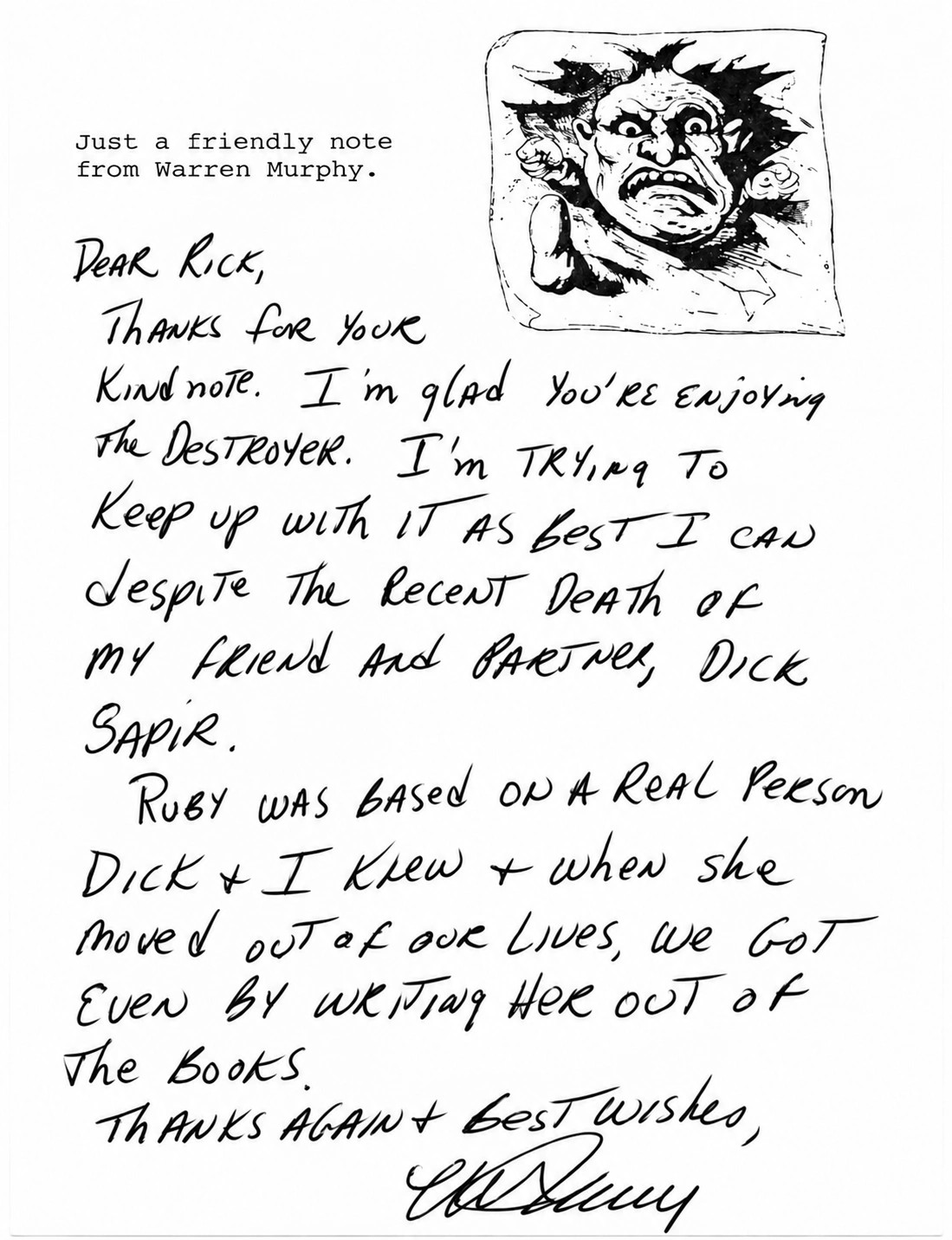
Read the letter (transcript)
Printed heading:
Just a friendly note from Warren Murphy.
Dear Rick,
Thanks for your kind note. I'm glad you're enjoying The Destroyer. I’m trying to keep up with it as best I can despite the recent death of my friend and partner, Dick Sapir.
Ruby was based on a real person Dick + I knew + when she moved out of our lives, we got even by writing her out of the books.
Thanks again + best wishes,
Editorial context & references
Contains spoilers for the series.
A photograph from an eBay listing shows a letter attributed by its seller to Warren Murphy. The stationery bears his name, and a signature is visible. It offers a personal glimpse of Ruby’s story, while the seller’s attribution remains the basis for connecting it to Murphy.
In the letter, the writer says Ruby was based on a real person known to the writer and Dick Sapir. The person is not named, and the passage gives no identifying biography. It is a striking account of inspiration, preserved in the writer’s words as they appear in the photograph.
The writer also connects that person’s departure from their lives with the decision to write Ruby out of the books. No novel or scene is named, and the passage does not say that the real person died. The recollection invites readers to look again at Ruby’s fictional story, while the novels remain the source for what happened to the character.
The letter is addressed to “Rick,” but the surname is not visible. It has no visible date; the writer calls Sapir’s death recent, a relative clue that does not supply a year. Those small absences are part of the object’s story: readers can hear the writer’s recollection without filling in identities or dates the letter leaves open.
Series publicity uses the name Ruby Gonzalez, but no reviewed source yet connects that character to the unnamed person in the letter. The feature can sit beside Ruby’s character page as a separate creative-history account, with any link between the artifact and her fictional appearances kept under review.
Part of the letter’s appeal is how small the revelation is. It ties a writing decision to people the writer knew, then leaves the real person unnamed and the fictional event unexplained. That gap invites a reader to hold creative recollection beside the novels, rather than letting one replace the other.